It’s strangely apt to be writing the following just as the Tailteann Cup semi finals are down for decision. The point was made not so long ago on these pages that hurling was ahead of football in coming up with a tiered championship.
Because of the inception of the McDonagh, Ring, Rackard and Meagher Cup competitions, players from what might be titled less prominent counties have the opportunity to display their skills and ability to a far wider audience than would previously have been the case.
Most recently, there was no finer display in Croke Park than that of Tyrone forward Damian Casey against Roscommon. Today, the Dungannon clubman passed away suddenly in Spain. Tomorrow is promised to none of us.

Which indescribably increases the appreciation at being able to view moments of sporting brilliance such as that which illuminated FBD Semple Stadium on Saturday. If one was to put it a certain way, things went very much with the form book.
However, things going according plan is very much a subjective, one sided take on any situation. Both sides in any match will have expected to win and planned accordingly. Alas it can only work out for one.
In the first half of the double header, Galway were entitled to enter as favourites having tangled with Kilkenny whereas Cork had, with respect a much more straightforward passage to this stage when seeing off Joe McDonagh Cup victors Antrim.
The ability within this Cork team is beyond doubt. In Sean O’Donoghue, Mark Coleman, Ciaran Joyce, Darragh Fitzgibbon, Robbie O’Flynn and Pat Horgan, they lay claim to some of the finest current exponents of the game there are. Yet, the inclination that these Rebels are hamstrung by a soft underbelly is difficult to dispel.
Going back as far as 2013, they should have had Clare well and truly put away before Domhnaill O’Donovan essayed that incredible equaliser between the posts at the Canal End. If that’s not evidence enough, Exhibit B would absolutely be last year’s All Ireland Final no show.

Here, if they were feeling any way fragile beforehand, the wound was even more gaping after just seconds when Galway’s Jack Grealish – the much more admirable one – had a point effort drop short, only for it to drop short, deceive Cork custodian Patrick O’Sullivan and nestle in the net.
To their credit, Kieran Kingston’s charges did work their way back into the contest rather quickly. Though the profligacy which would ultimately be their undoing reared its head very early on,
That wastefulness was compounded by the rather baffling decision of the Cork management to leave Horgan on the bench until half time. By which time they were in quite the trench after Galway’s most potent forward Conor Whelan had filled their net again.
Moreover, when Kingston et al did deploy the Glen Rovers great, the value thereof was arguably blunted before it had a chance to accrue by the decision to withdraw Conor Lehane. Instead, the two of them should have been left to operate together.
That said, all of Cork’s replacements did contribute handsomely, with Jack O’Connor, Horgan and Alan Cadogan each making big impacts. Yet, their 11 first half wides – 17 in total – would eventually catch up with them.

Galway have never been short of gifted stickmen. And yes they have achieved plenty, especially given the unique circumstances in which they operated for so long. Though for all that, a wait of 29 years from the time Cyril Farrell led a wonderful bunch of players to acquire back to back titles until Micheal Donoghue rebelled against famine and brought home the crown seems unfathomable.
One wonders, mind you, was it often a scenario similar to that which prevailed when Sean Boylan took over the Meath job in October 1982. Whereupon he told the players under his command “I don’t care if ye knock lumps out of each other in club games at the weekend, in here on a Tuesday and Thursday night ye are all Meath men”.
Whatever the reasoning, not surprisingly, Shefflin has everybody singing off the one hymn sheet. You notice that in perculiar little ways. Or, as was the case in this instance, how they reacted to what could have been a catastrophic setback.
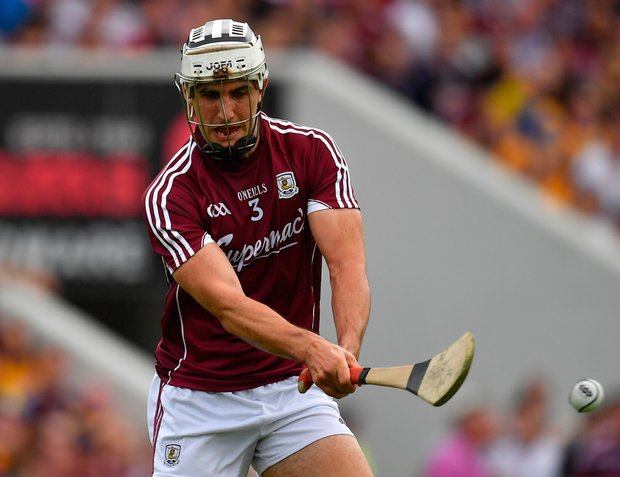
Mention has been made before of my belief that centre back is the most pivotal position on a hurling team. There are few better exponents of the craft than Gearoid McInerney. Though ironically, on this occasion, the white helmet was atop the No. 5 jersey.
Yet when the defensive colossus succumbed to a knee injury, the Tribesmen rearranged the pieces on the chess board and carried on.
Having had their onion bag burst twice, Cork needed a serious injection of something after half time and got it almost immediately when Shane Kingston netted. However, spirited as their efforts were, their wayward shooting left them with a chasm they could never breach.
While in no way attempting to make a comparison here, there is one obvious and important similarity between Shefflin’s charges here and the mesmeric team of which he was the spiritual leader. They have a standout player on every line on the field.
From Eanna Murphy between the posts, to Jack Grealish and Daithi Burke in the full back line, McInerney and Padraic Mannion at half back, David Burke at midfield and Conor Cooney on the half forward line.

When the bovine recycling was about to hit the wind generation instrument however, it was in fact the Galway replacements who made the most telling contribution with Jason Flynn, Brian Concannon and Johnny Coen all posting classy and crucial scores as they held off a spirited Rebel revival which in itself had been founded on the difference made by Ger Millereck upon his introduction.
Overall, Galway were deserving winners on the day but they will have to produce the same again and then some if they are to topple the champions.
Leave a Reply