Maybe I do know what I’m at after all. At the outset here, a shameless confession – outside of Meath, obviously, I’ve a fondness for Armagh greater than any other county. Perhaps for no particular reason, but broadly based upon: their people, their back-story, their song, Geezer, Francie, Jarlath Burns, Crossmaglen Rangers and the way they play their football.
In a piece earlier this year concerning the Offaly U-20 hurling team, I referred to them as ‘Earthy’, ‘Primal almost’, meant in the most complimentary manner possible. There’s a ruggedness about them, a simplicity about how they get things done and an absolute unwillingness to give up. All of the above are equally applicable to folk from the Orchard County.
There’s something different in the DNA of folk of Joe Kernan’s era. They’ve seen too much and been through too much. Facing down sh** is behind a button on autopilot on their dash. It recalls that line from Captain Mainwairing in Dad’s Army “Ours is not to wonder why, ours is just to do or die”. When Big Joe flung his All Ireland losers medal at the wall in the dressing room at half time in the 2002 final, no more needed to be said. It was Armagh’s homage to Clare’s “We’re going to do it” moment.

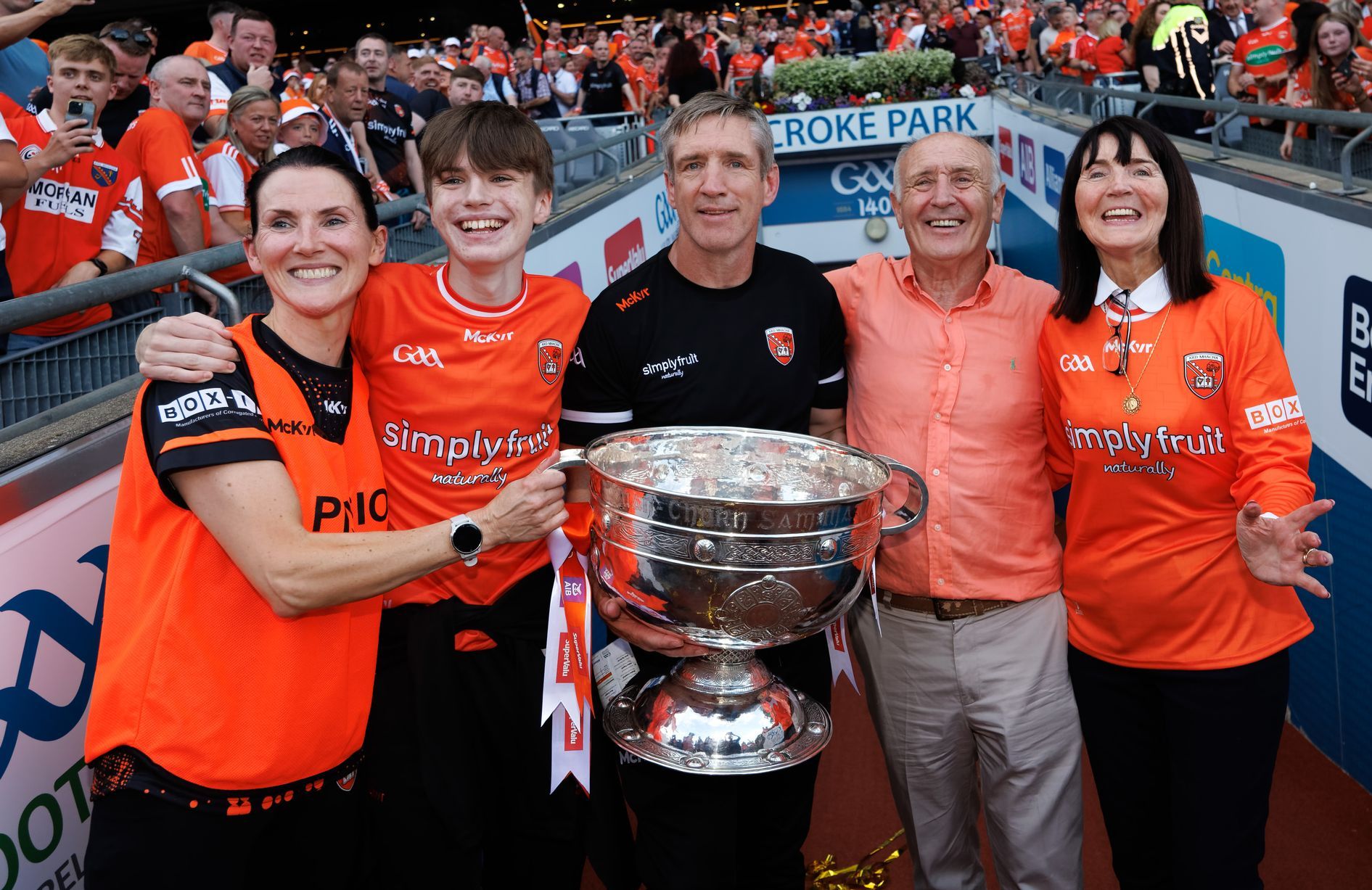
Kieran McGeeney doesn’t have many losers medals – if the ghastly boulders are still a thing – but Lord knows he and his players have accumulated enough heartache, on and off the field, to ensure the dressing room door was probably broken down rather than opened as they went into battle on the greatest day.
The irony in that being that there was a calm serenity about how they worked their way into the game via scores from Niall Grimley, Ben Creeley and Oisin Conaty. Though it has often been said, those whom the Gods wish to destroy, they first make mad. Rob Finnerty got Galway going with a beautifully struck free but immediately he did so there was a white flag of a different sort being hoisted as the corner forward pulled up quickly like a racehorse after losing its action.
Once Finnerty went off – which necessitated the introduction of Johnny Heaney way earlier than would have been planned for – it was as if the maroon and white ship had lost its auto steer. To be fair, the irrepressible Paul Conroy – ably abetted by John Maher and Cein D’Arcy – ensured Galway gave as good as they got in the first half, but still, there was something defining about Aidan Forker driving forward, curling over a truly magnificent score and clenching his fist thereafter just on the call of half time. Meaning the sides went in deadlocked at 0-06 apiece with, probably, only 35 minutes of their season remaining.
Conroy did set Padraic Joyce’s side on their way again at the start of the second half but, as all connected with them would have feared, the impact of having to run Heaney and Sean Kelly in off the bench so early began to tell, when, essentially, they were unable to meet fire with fire when Armagh began to empty their reserve list.

It was probably the source of much conjecture within the county and without that ‘Soupy’ Campbell was unable to force his way into the starting 15. Any matter can be viewed through an alternative lens mind you and – rather than being seen as a black mark against the soup – it would be contended to be a master stroke by the orange outfit’s Brains Trust. Simply as it was proven conclusively that, contrary to supposed convention, what’s traditionally served at the start of an occasion can work easily as well when stocks need replenishing.
Put simply, just as was the case with Jody Devine for Meath, Campbell is incalculably more effective coming off the bench than when starting. Moreover, as the influence of impact subs go, they don’t get much better than Soupy’s serving on Sunday.
This might be going along with the minority here, but it would be my earnest belief that the man from Lurgan fully intended passing that ball across the square for Aaron McKay to then spike to the net volleyball style in what turned out to be the crucial play of the game.
Dylan McHugh, Conroy, Maher and Shane Walsh did fight the tide to keep the Connacht champions within arms’ length but gut feeling always was that was as clos as the westerns were liable to get and, in the end, no game ever had a more fitting end than Rian O’Neill kicking the best point seen in there for many a day and, even more fittingly, when Jarly Og Burns was the last player to have possession of the ball before he and his dad lifted Sam Maguire together.
There are lessons for us all in how Geezer and his crew rocked the establishment and eventually got their day of deliverence. From several angles. Firstly, kudos to those in the county who had the patience and foresight to stay loyal to McGeeney and what he was striving towards. Copy and paste the same comments regarding the boss himself.
What’s more, and again the following may be going against the grain here, but what of it. Anyone who really has the best interests of the game objectively at heart will surely admit that the way Armagh playing their football is a breath of fresh air for a game headed towards life support due to monotony.
Just because something is deemed to be old or old fashioned doesn’t mean it won’t still work. What nobody seemed to notice – or conveniently chose to ignore – was that the all conquering Dublin teams under initially Jim Gavin and then Dessie Farrell play more ‘old fashioned’ football than anybody wants to admit. Brian Fenton letting long ball into Paul Mannion, Con O’Callaghan and Cormac Costello (just like Bernard Brogan and Dean Rock before them) with which to wreak havoc.
Now, whether there is any correlation between the following two factors is purely speculation on my part, but, en route to making Crossmaglen Rangers the greatest club football team there’s ever been, at the outset of their journey, Joe Kernan added Colm O’Rourke to his backroom team and thereafter the black and ambers practically patented playing long diagonal balls into Gavin Comaskey off which Jim and Oisin McConville dined and made hay.
Then, come 2002, when Big Joe was belatedly given the county job, the brilliant but luckless Ronan Clarke was the one stationed on the edge of the square and it was Stevie McDonnell and the younger McConville mentioned above reaping the rewards. Fast forward to now and, while the style of long ball going in may have altered somewhat, the basic premise remains the same.
Grugan, Murnan and Turbitt are the yin to McDonnell, Clarke and McConville’s yang. The only slight deviation being that, as well as letting the ball into the triumvirate up top, Armagh 2024 also have the option of kicking scores from further out the field courtesy of the aforementioned quintet of Forker, Grimley, Creeley, O’Neill and Conaty. Not to mention the incalculable contributions of Stefan ‘Soupy’ Campbell and Oisin O’Neill off the bench.
But you know, as is often the case, there were other external factors at play bolstering Armagh’s bid for greatness which carried more weight than anything directly connected to football itself. Namely, the tragedy which befell Armagh GAA – and the Grimley family in particular – last November with the death of Patrick (RIP) in a road accident.
I also know of another person connected to the Armagh camp currently engaged in a battle to which all too easily one can relate and it’s also known that – again similar to myself – Sunday’s result will have given them a lift of perhaps incalculable proportions.
Yet, there was another, albeit fickle factor at play. A lot of the time in sport, people don’t get what they deserve from it, on Sunday last, Kieran McGeeney’s greatness was enshrined and gold plated and from the magic dust of same, the rest of us got a top up of hope.

Leave a Reply