Transition. Movement. Change. Difference. Essentially, they all describe the same thing. But can have seismically different meanings for different people.
Indeed, they can have vastly fluctuating connotations for the same people in differing circumstances. Even for yours truly. For instance, the notion of doing Transition Year after completing the Junior Cert. appeared to be a no-brainer.
Now, ‘normal’ youngsters are, wrongly, put under enough pressure at the time of State exams, so, trying to undertake them with a disability only increases that tenfold.
That’s with everything going to plan. However, picture the following – this corner is just about to hit Print on English Paper 1 in the 1997 Junior Cert. when a construction crew working behind our house hit overhead power lines and knocked out the electricity.
The official solution? Joe Bloggs here staying in the school until 6.30 that evening to do Paper 1 AGAIN after doing the second paper.
Remember now, this was day one of the State exams. So by the time I was finished with them, Transition Year was part necessity part exciting opportunity. From one angle, you had physical and mental exhaustion from everything which went along with the actual ‘doing’ of the exams. From the other, two words jumped off the page – Work Experience.
For me, that meant either The Weekender, Meath Chronicle or LMFM. Of course, that was all grand in theory, but, as is so often the case, things don’t work out in reality as is hoped or expected when one is not able bodied.
So in all honesty and entirely at my own expense, it will regretfully be conceded that for me, TY was a bit of a waste. Mind you, even in sporting terms, transition quite often can be a lot more complex than it might seem.
It wasn’t always so of course. Go back to the days of Jack Quinn or Pat Collier or Pat Reynolds or Matt Kerrigan, when the long ball was the only show in town. How much of that was down to the weight of the pig’s bladder, we can only speculate.
From there, you had the game ‘graduating’ (positively? I’m not so sure) to the Kerry-Dublin duopoly from the mid 70s which lasted for a decade until Meath upset the apple cart in 1986 and Cork did likewise in the deep south the following season.
But here’s the thing, in those duels in the never-ending story, Kerry, in particular, went about revolutionising how the game was played. Which, for them, was a golden ticket to a golden era. From a neutral perspective, though, it led to the spectacle of the game being subjected to death by handpass.
On foot of which, to be fair, the Brains Trust acted by outlawing fisting or handpassing the ball to the net – unless the ball is in flight – the irony being that it took a route one long ball which Meath failed to deal with for Ger Power to score the second most infamous goal in Gaelic football history to beat down a rising Meath tide.
At this juncture it will be admitted that it was in the aftermath of the above that this writer became properly attuned to matters in GAA. What a blessing that turned out to be. Because for a period of 17 years thereafter, in my view, the best football in the history of the game was played. Until the present time.
However, in between point A and point B the game was again poisoned at the behest of Mickey Harte and Jim McGuinness. Via suffocating and nauseating blanket defending and hypnotising triangles of hand passing. The upshot of all the boring dross?
In fairness to Jarlath Burns, for all that I would have serious reservations about parts of his Presidency, the appointment of Jim Gavin to front the Football Review Committee was a stroke of genius. The formation of which has been the second most needed and desired piece of administrative change in the history of the Association. With only the abolition of Rule 42 superseding it in terms of importance.
Which is a grand segue into the real meat of today’s sandwich – the process of the evolution of how teams transition between attack and defence in the current incarnation of the game. With insomnia-curing bouts of handpassing mercifully no longer an option, teams have been forced to recalibrate how they effect turnovers and start new attacks.
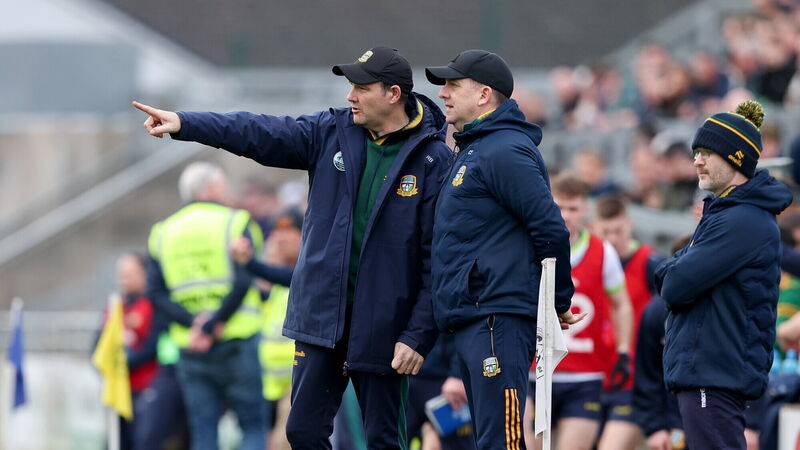
Which has given rise to Meath boss Robbie Brennan bringing in what he has termed a transition coach. Believed to be the first under that actual title, the Dunboyne man has recruited his club’s former hurling coach Conor Scully – who has also worked with the Na Fianna footballers in Dublin and Skryne in Meath – to optimise the changing of defence to attack.

It’s no secret that sports – and Gaelic football in particular – can and have benefitted greatly from the adoption of dictums from other codes. Like rugby and basketball Australian Football League. All of which have added greatly to the quality, attractiveness and entertainment value of our own ancient game.
Now, there are probably facets of all the aforementioned disciplines in how Meath go about territorial exits, but I would further add that – as was his norm – Sean Boylan was thinking outside the box about such things long before the three Ts – Tackle, Turnover Transition – long before they were the big buzz phrases in the game.
How? Well, by invoking the merits of defensive overloads. As in, not concentrating on making sure avenues to your domain are safeguarded, but swarming around whichever opposition player has possession and forcing them into overholding or otherwise fouling the ball.
Furthermore, while this corner would credit Brian Cody with introducing the concept of augmented defences in hurling via dropping the likes of John Hoyne or Martin Comerford back to augment raid repelling operations. But, to be fair, Boylan had been bolstering Meath’s rearguard action years before. By way of having ‘Jinksy’ Beggy and PJ Gillic sacrifice their own game in order to diminish the threat posed by Dublin’s half back triumvirate of Paul Curran, Keith Barr and Eamon Heery.

On that, it’s worth noting that the only time in the entire four match saga of 1991 that Barr ventured up the field was in the aftermath of the Erins Isle clubman and his sidekick Mr Heery making an O’Rourke-flavoured sandwich which left the great man prostrate on the sideline seeing more stars than Tom after Jerry clattered his hapless haranguer between two bin lids.
Now, while it is probably true to see there are elements of more sports in play with football today than ever before. Basketball’s full court press being the obvious start point.
For those not au fait with matters of the hard court, it basically means exactly what it says on the tin – a team who have just scored push right up on their opponents who are trying to play out from the back starting at their baseline (goal line). If they do find an exit strategy, usually one of things will happen. Either the press re-engages further out the field or those attempting to escape their own territory resort to a Hail Mary long ball which would end up coughing the ball up anyway.
Though in my view, to take Meath’s case as an example, the prevalence of rugby’s drift defence methodology is clear to see. Whereas since God was a gasun, the first battle cry of anybody coaching defenders has been ‘Get A Hand In’, Meath, over the years, in contrast, have perfected the art of dispossession with “No hands”.
A reference to the fact that, in the oval ball code, if one is trying to effect a turnover from a ruck, or indeed a set scrum, body weight can be deployed to dislodge the ball but players must not put a hand in. Thus, it was from that basis that Sean Boylan’s Meath teams perfected what I have long referred to as swarm defence.
Whereby they literally suffocate the life out of opposition attacks by surrounding their player in possession until they actually have no option but to foul the ball by overholding or other means. As an aside, it can only be pondered what it would have been like had the solo and go been in vogue when, say, Graham Geraghty was stationed in the Meath defence or the aforementioned, lauded Dublin half backs referred to above were in situ.
Moreover, it’s quite likely that at least some of you are thinking ‘How can he be extolling the virtues of swarm defence while at the same time be against the blanket? Are they not the same thing? Well, in my own humble opinion, no, they’re not.
Simply because, the fundamental of the blanket defence is to literally cover all their space, thereby forcing attacking opponents to double back on and/or second guess themselves.
Whereas, with the swarm defence, emphasis is – rightly in my view – based on overloading attention on the player in possession to a point where the oxygen is literally choked out of their attacking intent.
And, it is at that point where the rugby parlance is possibly at its most relevant and helpful. For you see, naturally, the nub of the swarm defence is to strip the incoming attacker of possession whilst not giving away stupid frees yourself in the process.

Which is why the bit of rugby mechanics comes into play. For those not au fait with the ‘laws’ (playing rules) of the oval ball code, once a player in possession is tackled, must release the ball.
The tricky part, though, is that the tackling player cannot just dive in and grab the ball or peg the player nearest to or in possession of the ball out of the way. Hence why you will constantly hear referees call “No Hands” or often simply just “No” if they spot a player even tempted to chance getting away with that particular infringment.
Still, however, defending players have to have means and opportunity to defend their territory.
Which is where the concept of locking onto or over the ball comes into play. If you want to talk about dark arts in rugby, that is where they will manifest. By way of somehow shunting the opponent off the ball or persuading it from their possession. There are none better than Tadhg Beirne in world rugby at executing that skill presently.
In a Gaelic football sense, the basic tenets are the same. Certainly from a Meath perspective anyway. Where concentration tends to focus on the No Hands element. Instead seeking to effect turnovers by weight of numbers and the body weight of those numbers.
Anyway, returning to the core reasoning for the existance of what you are reading – the importance of and complexity in transitioning from defence to attack, of course, regaining possession is one thing, it’s what you do with it when you have it that makes the real difference.
Now, it seems to be widely accepted as fact that, during his glory-laden tenure as Dublin manager, Jim Gavin’s dictat with regard to restarts was that the ball had to be dead at the other end of the field within 16 seconds. Now there’s no suggestion that Robbie or Conor have our lads under a time limit, but they have them transitioning in a very exciting looking direction and at quite a lick too. Long may it continue!
Leave a Reply