They say it’s the hope that kills you. Through a certain lens, that’s a very easy stance to understand. However, from another viewpont, if you didn’t have the hope, would the wheels keep turning?
In my case, the answer to the immediately above, the definitive is most certainly no. Though the thing is, we, as Meath GAA supporters, were so spoiled last term that anything remotely less was going to feel like an awful let down.
After all, the lady footballers reached an All Ireland Final, the senior men dropped only one shot shy of that while the lads Minor team qualified for the All Ireland B Final, whereas, with the obvious and crucial exception of the lads attaining promotion back to the top table in the NFL, the inescapable feeling is that Meath teams simply haven’t been as competitive as was the case 12 months ago.
Now, in the cases of the senior hurlers and lady footballers, their reduction in productivity is actually depressingly easy to decipher. You simply cannot be bereft of the raft of quality players as is the case in the two relevant instances and hope to prosper.
In the case of the hurlers, you’re talking about players of the proven ability of Brendan McKeon, Evan Fitzgerald, Jack Regan, Eamonn O’Donnchadh, Nicky Potterton, Cian Rogers and the McGowan brothers. Take a glut of commensurate players off any team and there will naturally be a diminishment in their output. Just look at the impact not being able to call on Huw Lawlor and Billy Ryan (possibly among others).

Switch those calculations to the Meath lady footballers and that impact is even more pronounced and tough to take. Nowhere more than in the environs of my own club. Being as we are, minus the services of the incomparable Wall sisters, Vikki and Sarah. Add to that in the context of the county team, Aoibhin Cleary, Orlagh Lally, Mary Kate Lynch and Aoife Minogue (at least) and it may seem somewhat natural that Meath’s would have regressed somewhat.
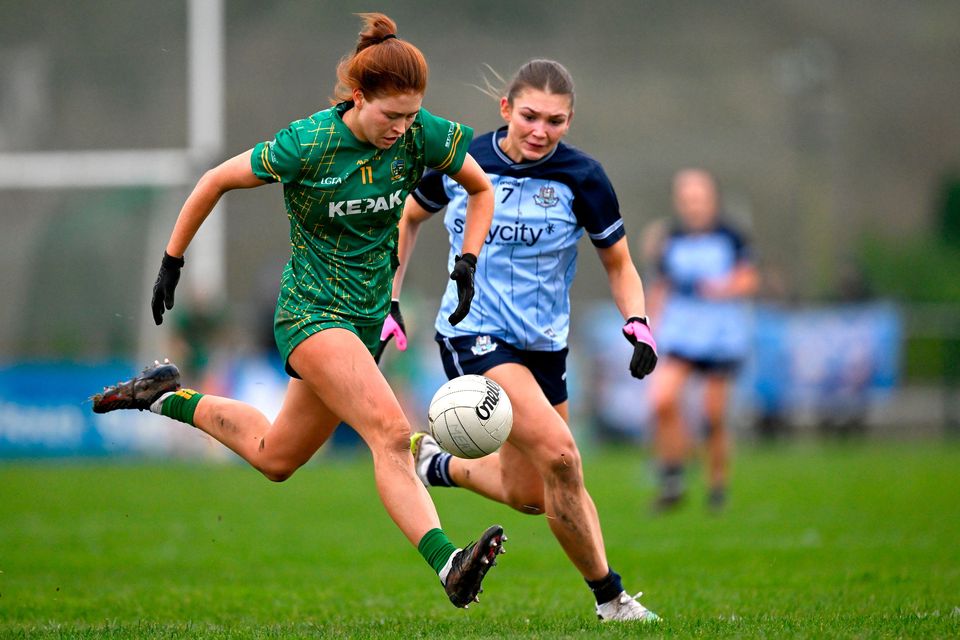
Muddying the waters somewhat is the fact that the Royals did, indeed, contest the All Ireland LSFC Final last August. Albeit that they were resoundingly beaten by the Dubs on that occasion and in the interim the younger Wall sibling, Cleary and Lynch have all been tempted to the bottom end of the world.

Then, even though in some ways even I myself can see why the following might be viewed as harsh, surely questions must be asked as to what were the inefficiencies which saw our male Minor footballers lose three times throughout their season. Four if you count the penalty shootout against Kildare, but, on a point of principal I can’t bring myself to. That is only one of a number of glaring unfairness’s with regard to inter county Minor competition.
The following is not meant as a criticism of anybody involved with this year’s Minor group, but, there’s an awful feeling that it was a campaign which could have delivered much more. I’d have my on views on a few things, but, as, over the course of a 24 hour period, three different county teams – lads Minor footballers, lady footballers and camogie team – suffered shuddering setbacks, temptation is to cast the net of inquisition a bit further.
However, before digging too deeply into the nuts and bolts of things, the genuine progress made with both coaching and competition structure which in turn, notionally at least, lead to better levels of competitiveness from our county teams, must be acknowledged.
Where the problem lies, though, is that, for all that Meath have, beyond debate, improved both structurally and in terms of results on the field, gut feeling is that there are at least a few other counties have moved on again, commensurately, from where Meath currently reside.
While, in one way it almost feels unfair to be comparing other entities to Tyrone given the astronomical run of success the O’Neill County have had at underage level in recent years, that they have done so is surely the benchmark by which others should be setting their benchmarks.
The following may seem a little tongue-in-cheek but surely the question must be asked, if they can do it why can’t others? Knowing the mindset of Ulster counties, it would be my contention that regardless of what the financials were for any of the teams up there, there’s not going to be a huge deal made out of that side of operations.
So, if its not a money thing, what sets them apart? The point being, also, that Dublin – wrongly in my view – are the only ones who end up with their funding out in open country. It should be all or none in such situations.
But if its not down to money, what are the progressive and continuously successful teams doing that sets them apart?
Outside of Dublin, Tyrone, Louth, Westmeath and Roscommon have all been upwad curves relative to what would previously have been regarded as their standing.
I would be very reluctant to say Meath – in the case of the senior men at least – have gone backwards, but there feels like there ought to be a sense of urgency about ensuring that doesn’t become an issue. With the camogie, ladies football and hurling teams the fluctuating fortunes are quite understandable given the turnover of both players and mentors within the groups concerned.

However, the challenging bit is ensuring (a) that the transitions within the teams concerned are as smooth and non disruptive as possible and (b) that the senior footballers are in a position to effect the sort of ongoing transition required to ensure maintenance of competitiveness at the highest level of competition.
The conundrum, I suppose, is how you arrive at achieving that goal. Development Squads have long been a ‘thing’ and indeed it would have been felt in many places – including this seat – that we were quite late to that party in these parts. To break it down even more simply, it has only been since the excellent Paul Garrigan has become centrally involved with the coaching of county teams behind the scenes.
And in fairness, on foot of same, the progress made by our underage teams for the past few seasons speaks for itself. Even if, ironically enough, there’s a tinge of regret that both the Minor and U-20 footballers could have got more out of their respective campaigns than was ultimately the case.
But here’s the thing, what’s the best way to ensure the vital continuity and throughput of players required to achieve the end goal? Development Squads certainly have their merits – the utter dominance of Dublin in the Jim Gavin era boldly underscore as such – as Tyrone and Donegal also espouse with their farming of underage titles up north.
Yet there’s also a cohort who appear not to be fans of the Development Squad concept at all. As best evidenced by the admittedly outspoken Andy Comerford openly opining that, from the perspective of those down Noreside, they have either ran their course or were never worth the store placed in them in the first place.
From a Meath viewpoint, I would have to say that, since their inception in these parts, the improvement in the productivity and throughput of players from our Minor and U-20 teams has spoken for itself, but, above all else, the fundamentally crucial point is that the processes in place are maintained and expanded upon.
Leave a Reply