Tipperary’s sensational All Ireland MFC victory of 2011 has a spot ingrained in the memory bank of yours truly. For a start, their tilt thereat only came about after Meath were absolutely robbed by Derry referee Barry Cassidy in their quarter final tie against the Premier County in Portlaoise on the August Bank Holiday Monday of that year.
What was a perfectly good goal by Ratoath’s Bobby O’Brien being heinously ruled out for a supposed square ball that was as far out as Nigel Farrage in a popularity vote in the EU. Though in fairness to David Power’s side, when they got their opportunity they didn’t half grasp it.
Stunning what, with hindsight, between that year and the following one, was possibly the greatest Minor football team ever assembled in the same set of jerseys. Comprised of but not limited to – Evan Comerford (as sub goalie at the time), Eric Lowndes, Jack McCaffrey, Emmet O’Conghaille, Conor McHugh, Cormac Costello, Paul Mannion, Davy Byrne, John Small, Niall Scully, and, most significantly, one C. Kilkenny. Add up the aggregate number of All Ireland medals there, I’ll wait!
However, what the majesty of that Dublin group also does is, from another angle, pay a massive compliment to those who claimed their scalp on that famous day. Colman Kennedy may ultimately have been the Tipp player who ended up with his name in lights – his last minute rocket having Ross O’Hanlon empty his onion bag for a third time that same afternoon, but, a cursory glance at the rest of that Tipperary team sheet gives you some indication of why they made the highly commendable progress that was the case in the years which followed.
Said elevation eventually plateauing with an All Ireland SFC semi final appearance in 2020 after two members of that magnificent Minor amalgam – Colin O’Riordan and Michael Quinlivan – had inspired those who donned white and green on the day to sensationally usurp Cork and claim what would be now known as the Paidi O’Se Cup for the first time since God was a gasun.
Aiding and abetting O’Riordan and Quinlivan in the construction of history at the time were brothers John and Liam McGrath of the magnificent Loughmore/Castleiney family, Bill Maher, Ian Fahey, Seamus Kennedy, Steven O’Brien and Evan Comerford – yes, another one, who was also a superb goalkeeper!
Most, if not all, of them were also on board on the occasion in the run in to Christmas of 2020 (everything being held up by the Covid-19 chaos which was allowed be inflicted on the masses) when the two sides were on a collision course in the latter stages of that season’s Championship.
Mind you, from a personal perspective, their coming together of 2011 brought to mind the same two counties meeting at the same level in 1984. The year, not the George Orwell novel. Primarily due to the presence of my dear friend Sean Barry on the Dublin team. No, I am not old enough (just!) to recall details of the season or the like but Sean’s involvement always peaked a bit of personal interest therein.
And, as it happened, the similarities between the two seasons are striking. On both occasions, the two shades of blue triumphed in both hurling and football at the U-18 level – as it was then. True also that there were individuals thereon who went on to achieve superstardom. Except in the earlier case that statement requires a modicum of qualification.
Yes, Paul Clarke went on to be one of the finest – and most scandalously under appreciated – footballers of his generation. But, on the Dublin hurling team which defeated Tipperary to initiate the double possibilities was a certain Niall Quinn. Who went on to attain fame and fortune with Arsenal, Manchester City, Sunderland, Forpaddydplasterer and the Republic Of Ireland. Even if he was – as Eamon Dunphy rightly pointed out – a creep in the middle of all the bullshit which erupted over Saipan. When all any fella was interested in was covering their own arses instead of backing their Captain (who was 100% correct) and the greatest exponent of Association football this part of the island has ever produced.
***
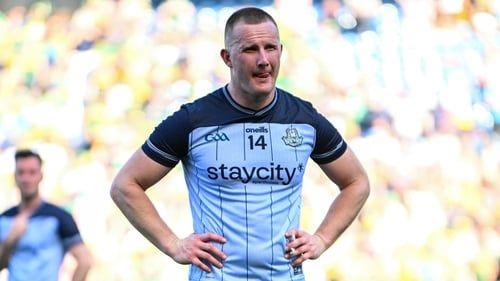
Whatever about the Saipan side of things, that Dublin Minor football team of 2011 has been on my mind in recent days. With the news that the brightest beacon within that illuminating bunch – which is saying something – Mr Kilkenny – brought the curtain down on one of the most remarkable inter county careers the organisation has soon.
Eight All Ireland SFCs, 13 Leinster SFC medals, six National League souvenirs and a similar number of All Stars. That’s only at senior level, and only the football.
Ciaran also represented Ireland in the International Rules Series and was an absolutely outstanding hurler at inter county level also t – as ttt tplayers are now shamefulltty made do – the Castleknock clubman was made choose between big ball and small.
An utterly ridiculous situation which there should be absolutely no need for. Which is why it was so upsettingly disheartening to hear Jimmy Barry-Murphy, of all people, blurt “We’ll probably never see dual players at inter county level again”.
There’s absolutely no need for such to be the case. Nor should it be tolerated by the powers-that-be. Players now are that well catered for by way of physios, doctors, R&R, nutrition, GPS tracking and Lord knows whatever else, there’s no discernable reason why dual players couldn’t train one night per week with each code and that should be more than enough. Teams, even at club level, train far too much. And most of the reasoning behind that is psychobable bluff.
Mind you, even besides all of what has been said here up to now and what will follow hereafter, there’s another reason why I have the utmost respect and admiration for the man who was once possessed of a head of flaming hair. Namely, that he has in him a quality which, disgustingly, half the world appears to be bereft of – loyalty.
To my knowledge, only Shane O’Rourke, Ciaran Kilkenny and David Clifford have had the gumption and decency to turn down the foreign dollar and give of their best for club and county. In all cases the cases in question, the results have spoken for themselves. First as my dear friend from Simonstown was able to – temporarily at least – put years of torture at the behest of a dastardly hip injury behind him and almost singlehandedly lifted the Gaels to their first and so far only pair of Meath SFC triumphs.
Unlike so many others from closer to home who have taken to the skies with such alacrity one doesn’t know whether to be angry or just genuinely upset that those with whom they are affiliated may never reach their full potential collectively because of their absences.
Meanwhile, the other pair of gems have won everything it’s possible to in Gaelic football multiple times over. With possibly the only atomic particle splitting the two being the fact that Clifford has also seen and done it all at club level too with Fossa and East Kerry.
***
So, what, then, you might ask, set Kilkenny that bit apart from his glittering cast of peers? Well, from an outside viewpoint looking in, the first thing the strikes you about him is that he strikes you as a man with a lot of admirable old fashioned qualities in a younger person. Hard work, patience, leadership and composure. Above all else, though, a football (and hurling) intelligence which simply can’t be coached.

Perhaps the greatest illustration of which was the rapidity with which Kilkenny became the brains and pivot of everything good about the Dublin team of which he was. And by God was it good!
The greatest the old game has ever seen. Now, if you have been ingesting content in this space for any length of time, you will know of the long held view in this corner that there are two different ways of playing the centre forward role.
You can either stand toe to toe with the opposing No. 6, trading blows, you could say, as Colm O’Rourke and Keith Barr did for the vast majority of the epic four match saga of 1991.
Or, my preferred version, the role on the ’40’ can be played in what I like to term a ‘floating’ fashion. Roaming around the field, being the ‘out ball’ for their defence as well as starting and finishing attacks.
For as long as this writer can recall, Dublin have always favoured the latter methodology and had exemplary practitioners of it. From Tony Hanahoe, to Jack Sheedy, Dessie Farrell, Declan D’Arcy, Alan Brogan and, for the past decade and a half, Ciaran Kilkenny.

Except that, for the entirety of the time Gaelic football was bathe under blue and navy skies, not only did they seismically alter the role and importance of the half forward line, but Kilkenny could’ve been actually patented as the first fully functioning quarter back in the game.
As in, literally with every Dublin team he’s been on for the length of his career, everything has gone through him. For as long as he was in situ, James McCarthy halved the workload, at least, but since the brilliant Ballymun man bowed out, Castleknock’s Kilkenny has had to do most of the heavy lifting on his own. Moreover, the longer he went on, the more arduous the load became.
Be that as it may, there’s one aspect of Ciaran’s career I’ve wanted to write on for a very long time but always said it could wait until he had taken his leave of the biggest stage. Why is not entirely certain, other than the possibility it would read better as a reflective piece.
Even though some of what will be contained hereafter has been touched upon already. Namely, the manner in which – during the Jim Gavin era in particular – the role of the half forward line, on the Dublin team in particular, was transformed.
Depending on how far back you want to go, Bryan Cullen, Paul Flynn, James McCarthy (he played nearly everywhere) and more recently Ciaran perfected the art of finding and slipping into pockets of space amidst pedestrian chaos into which Stephen Cluxton and, latterly, Comerford could dispatch restarts with laser like accuracy.
But there was even more thought and precision to it. Which, in fairness, over time, certain teams did decode to some degree. Though the fact that the utility forward was the axis on which it all spun never changed. Whether it was being the kickout outlet, driving forward and kicking scores or, what I will most miss, even from an opposition viewpoint, him the master of the closed fist signal up in the air and directing whatever it meant.
So now that he has hung the blue and navy vesmans up for the final time, there may be a want in the forces that hasn’t been there in a very, very long time.
The onus will be on the remaining elder lemons like Brian Howard and Niall Scully and Con O’Callaghan and Paddy Small and Cormac Costello to point the way. A mooted return for their flying doc certainly wouldn’t do their chances any harm.
Even so, the platoon will still need augmenting via the likes of Eoin Kennedy, Charlie McMorrow, Alex Gavin (with a summer’s experience behind them), Ethan Dunne, Noah Byrne – if they can keep hold of him – ditto Mo Salami – while I would still expect somebody in Dublin to somehow get to the bottom of whatever happened to or with Ciaran Archer. Their football team will be much the better if they do.
As for Mr Kilkenny, it is surely a certainty that he will remain involved in GAA in some capacity. Whatever it turns out to be will positively be improved for his input. He’ll be missed on the pitch.
Leave a Reply