Relax. Reference is not being made to King Charlie’s money grabbers. Rather one wonders is it time to convene a hurling equivalent to Jim Gavin’s Football Review Committee (FRC). Perhaps called the Hurling Management Review Committee. Hence the play on words!
Hurling needs a review. That is not, in any way, to detract from the brilliance of Limerick. Most recently or throughout the season or indeed for the better part of the last decade.
No more than when Dublin were streets ahead of everybody in football, that John Kiely’s side have once again chissled out a chasm between themselves and the rest is hardly their fault. Or problem to remedy.
Granted, it could and no doubt will be pointed out that Clare and Tipperary lifted Liam Mac Carthy in the last two seasons (both defeating Cork) so the understandable theory would be that Limerick can’t have got that much ahead of the rest, right?

Wrong. Whether it was down to the 63 meetings in a row or player frustration at dropping short over the last couple of seasons or certain other extenuating factors promulgated a bit of a siege mentality we may never know.
But what is certain is that, while Tipperary, Cork and Clare have stagnated at best, Limerick most definitely went up several gears from the last couple of years. Having done so, that showed just how far the Shannonsiders still are ahead of the rest.
And the reality is that, such is the gulf between the best and the rest that it appears only reform of the playing rules commensurate to what the FRC has done for football – because there’s not a whole pile can be done with competition structure – can give the small ball code back its sparkle.
If those in positions to do so have the gumption and desire to enact such change, they won’t have far to look for ideas. After all, following on from Gavin’s group, Ladies football has also introduced the Mark, the Advanced Mark, two-point scores and similar defencive stipulations.
For their part, the Camogie Association – under the direction of Meath’s Karen Dessain-Gellinet – have certainly permitted the taking of line balls from the hand. Whether they went through with the other proposed changes mooted at the time I am not sure but there were plenty of bits in those ideas which could and would amply add to hurling’s goodie basket.
I know there was also talk of a ‘Mark’ for high catches and (I think) possibly two point scores from further out the field. Whatever about any of the others, two points for certain scores is something I’ve been advocating for for years now.
Not in bug bear sort of way either. Merely because – as with the dictum curtailing the number of consecutive hand passess in football which was trialled 32 years ago, two-pointers for a sideline cut in hurling was tried out around the same time and, as with the football experiment, it’s something which never should never have been done away with.
It’s funny, in the aftermath of last week’s All Ireland, there was a contrast in the way things were analysed by different pundits and reporters. On one hand, there was a view that DESPITE Limerick’s brilliance, the game was still in need of remedial action.
However, the alternate view would opine the BECAUSE of how far Limerick appear to be ahead of the pack, the game is in need of serious surgery. Which would tie in with the notion that Cork and Clare and Tipperary have stagnated to some degree.
That might seem a tad odd given that the latter pair won the previous two All Irelands, that the same two teams have also garnered success at U-20 level under Brendan Cummins and Terence Fahy respectively but they certainly haven’t performed to the levels the playing talent at their disposal should allow them to consistently at the highest level.
Mind you, of even greater importance than those mentioned heretofore are those who have not been until now. Kilkenny, Wexford, Waterford – and Offaly if you like. Though in fairness to the latter, they have made commendable progress under Johnny Murray in recent seasons.
The challenge now, however, will be to maintain that forward propulsion with Adam Screeney set for a prolonged spell on the sidelines and a heartbreaking cloud of doubt hanging over the playing career of Faithful County captain Charlie Mitchell.
So to Wexford who, in fairness to them, were, as is often the case with the Yella Bellies, were only a few bouncing balls going their way away from being involved at the business end of the Championship.
And, while looking in from an outside perspective there would be a mild degree of surprise that Keith Rossiter stepped aside, the Wexford Co Board have done the most astute bit of management business seen in GAA since Limerick appointed John Kiely with the recruitment of former Waterford boss Derek McGrath.
Whilst at the time of typing the makeup of McGrath’s backroom team is not known to yours truly, if it is taken as read that top of the new boss’s To-Do list will be to persuade Lee Chin to go to the well again, former Sunday Game contributor McGrath will still have some serious weaponary to go to war with in the guise of Mark Fanning, Liam Ryan, Richie Kehoe, Corey Byrne-Dunbar, Cian Byrne, Simon Roche and, if you’re from Wexford you’d be hoping, Jack and Rory O’Connor.
Elsewhere, Tipp have, sensibly in my view, given Liam Cahill a fresh endorsenent while those formerly managed by both McGrath and Cahill – Na Deise – will possibly be disappointed that Brendan Cummins has ruled himself out, in Stephen Molumphy they one of their own on the up in the coaching ranks.
Also, though the gentleman’s name currently escapes me, the manager who led the white and blue to All Ireland MHC glory most recently surely also deserves consideration. Especially with exciting young talents like Mark Hartley and Cormac Spain setting out on their inter county journeys.
Regardless of who’s managing what team though, I believe that only tweaks to the playing rules will go some way in giving the small ball code a lift so as to ensure the gloss isn’t taken off it any further. To begin with, the Brains Trust could use the following as a starter.
(a): A ‘Mark’ and free to be awarded for an overhead catch once the ball has travelled a defined distance.
(b): The player who calls/is awarded the Mark must take said free.
(c): Scores directly from sideline cuts to be Two Pointers.
(d): Likewise for scores from further than your opponent’s 65m line.
(e): Puc outs to be taken from the ground so as to generate a contest around midfield.
(f): The three up/three or four back dictum be introduced along the same lines as in football.
(g): While a ban on short puc-outs would be extreme and most likely counter productive, there should be a directive that they reach your own half back line at least.
(h): The Black Card rule to be applied consistently and properly.
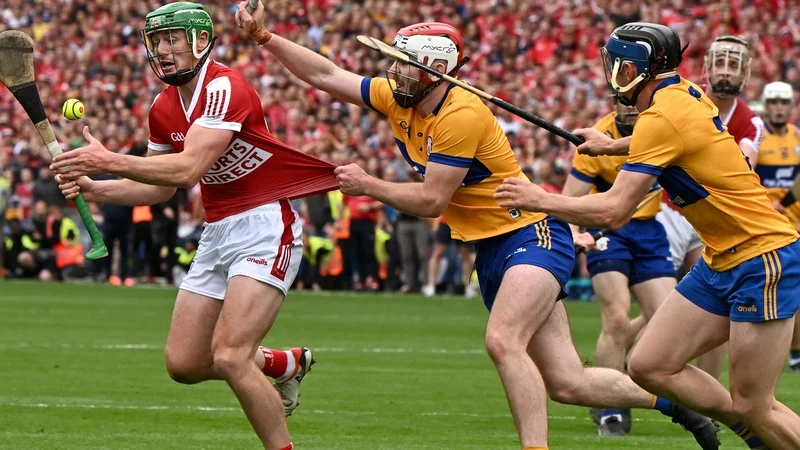
(i): Proper and total roll out of HawkEye technology at all inter county grounds and to be used for contentious issues other than scores. The manner in which Cork’s Robbie O’Flynn had the jersey nearly pulled off in the last play of the 2024 All Ireland Final should be evidence enough that assistance is required in that regard.

(j): Across all GAA codes, the 20-minute Red Card, as seen in use in Rugby, needs to be considered – at the very least – for introduction in our sports. Now, I can almost see the eye rolling and head shaking from here. However, though purists will probably shriek at the following, given the dynamics of how our games are now played, I believe it’s unreasonable to expect any team to play a match for an elongated period of time minus a player.
Don’t get me wrong, if a player does commit a serious transgression, they should absolutely face expulsion from the game in question and suspended for a period thereafter. For those not au fait with how things operate in the oval ball code, a referee can order a player off the pitch and refer the incident to The Bunker – which is basically Rugby’s version of VAR – and the Television Match Official (TMO) who can then determine that the player who transgressed can be replaced by another after the team of the offending player has operated with a body less for a period of 20 minutes.
Mind you, whatever about the disciplinary elements of the above ideas, it’s more likely that those relating to the Mark and minor adjustments regarding scoring which are of greater importance at this point in time. Simply because, John Kiely has very obviously engrained in his players that 30 points is the bare minimum required to win any game at the highest level now.
Thus, anybody even entertaining ideas of lying up with them, never mind harbouring ambitions of usurpation, would have to get treble ten at least. How many could honestly hope to get there without rule change?
Leave a Reply