I have very mixed feelings about Lourdes, the place of Holy pilgrimage in France. At least partly down to my own youthful (as it was then!) naievity. Having been there twice, certainly the second time, when I was just turned 13, muggins here had himself fully convinced there was going to be a miracle and the walking aid and wheelchair would be surplus to requirements.
Again, keeping my thought process at the time in mind, when that obviously didn’t transpire to be the case, to say in the one seeing eye here, the place wasn’t all it was cracked up to be would be the understatement of this or any century.
A view further clouded by revelations which would emerge years later, but that’s another story. On mature recollection, though, greatest gifts from the place of the ice cold baths had actually accrued on our initial trip thence when the occupant of this seat was only for years old.
Namely, and as is so often the case, the friends made thereon. Like the Mallon family from literally across the fields from us though whom we had never known up to that point, the McQuade family from Banbridge town in the County Down we met one morning that July (really) and, of greatest significance to what you will read hereafter, the Blair family from Crossmaglen in the Co Armagh.
Christy, Gene and their mother Mai. There may have been others in their touring party, but, after 41 years, Mai and “her two boys” are the ones of which clearest recollections are held.
Indeed, such was the way in which my late mother, my brother Paul and I hit it off with the Blairs that the three of us, along with my sister Barbara, ended up holidaying in Cross’ on two separate occasions while our hosts then also made similar excursions down this way thereafter.
While we were up north, as far as can be recalled, my two siblings both worked with the brothers’ travelling video shop – it really was a different age – but at the time my greatest fascination was being able to BMX bike racing on what is assumed was BBC.
However, by the second time we headed north, circa 1988, I was a lot more attuned to all things GAA with Meath having won Sam Maguire for the first time in two decades the previous autumn. Hence, an awareness of St Oliver Plunkett Park – the epicentre of the incomparable Crossmaglen Rangers GFC very quickly manifested.
Not in the sense that might appear to be obvious. Initially at least. No, to 7-year-old me it was a scary earthquake of a spot because of the RUC helicopters on and adjacent to same. And which for me at the time meant wheelchair having to be got to somewhere of shelter or, worst case scenario, held down so as to not get turned over as the choppers came in to land. Yes, exactly like the opening credits in Father Ted.
It was only as years went on, and quite honestly when Joe Kernan brought Colm O’Rourke in as an advisor prior to Cross’ playing in their first All Ireland Club Final that the story of the club and the area was latched onto once again. Mind you, back then, I don’t think even they themselves could’ve visualised their club becoming the inspirational phenom it has to so many. Even those of us not connected to the club itself or even Armagh.
Probably due to the Colm connection, a piece was keyboarded on my machine of the day entitled Working Away In The Shade. In general, it was relating to how the GAA in the six counties succeeded against the adversity of The Troubles. For example, the Antrim hurlers getting to the All Ireland Senior final in 1989 and Down (twice) Donegal and Derry annexing Sam Maguire in the midst of six of our counties being occupied by invading foreign forces.
It would be remiss, however, not to acknowledge that the piece largely revolved around Cross. Specifically, the extraordinary levels of success which began under Big Joe and Rourkey and was carried on by the McEntee twins and Oisin McConville and Gareth O’Neill and John Donaldson and Anthony Cunningham, probably among many others.
To fully understand and even attempt to partially document the Crossmaglen story, you must start with the families. Many of whom have been mentioned in the lines immediately preceding. But, for me, you can parse that down still further to the McConville family and various extensions thereof.
Think of the team as an engine and the McConville’s as the adaptable socket wrench required to keep it in working order and performing at its optimum. And, just as the attachments and hardware are interchangeable on the socket wrench for whatever the task may be, the importance and impact of the machinery does not.
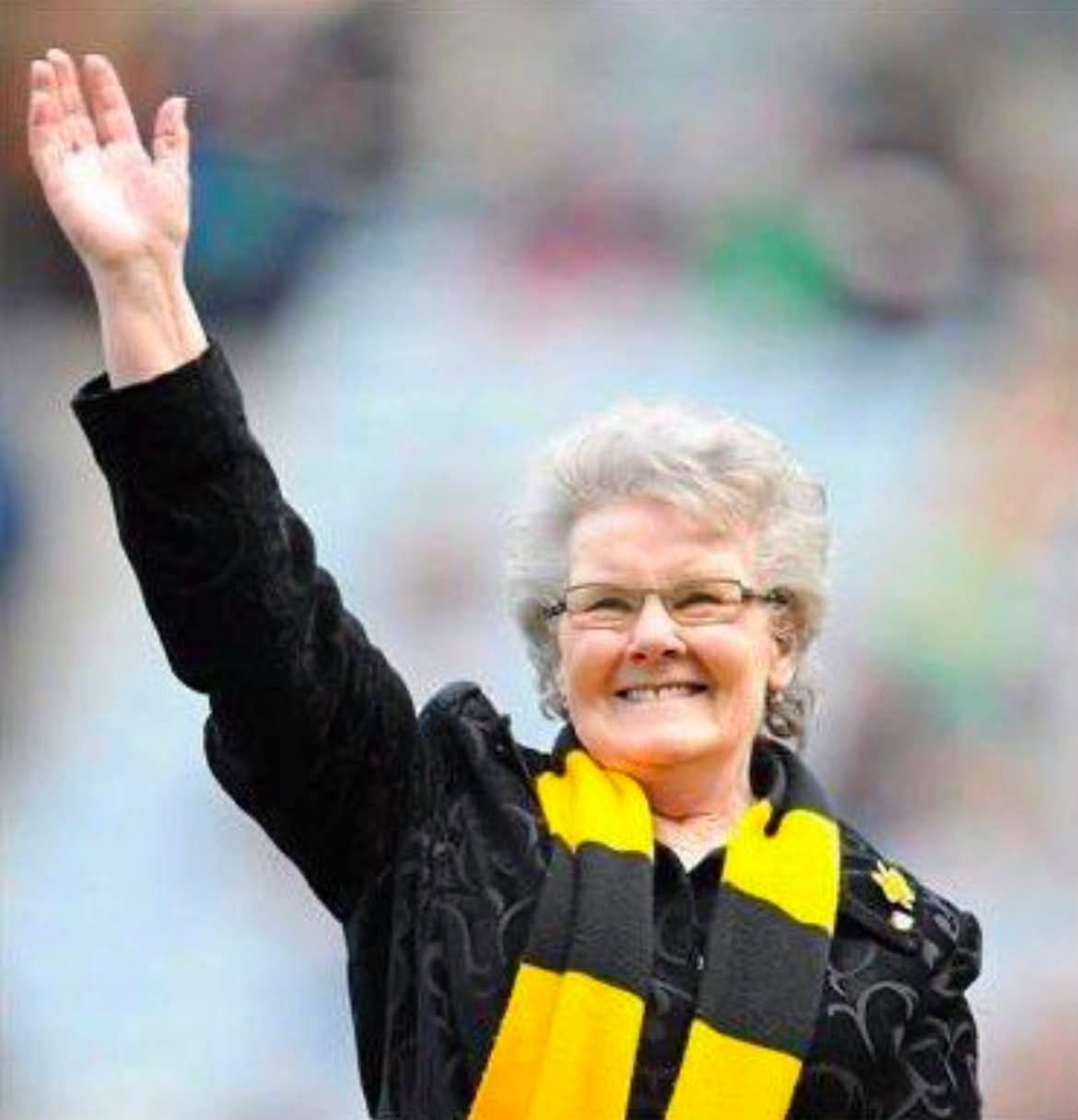
Mention of the name McConville and Crossmaglen in the one sentence will always be emotive for reasons which stretch far beyond anything which transpires on a football field. But, out of respect to the matriarch of the great dynasty of Gaels who took her leave of this life earlier this week, focus will be maintained on sporting matters here.

What is the definition of great Gael? Truth is there’s probably no indisputable one, but, if chroniclers of such things were to the pin of their collars, they need look no further than Mrs Margaret McConville.
Now, at this point, it will be admitted that one is unsure as to whether the two McConville families are connected, but, even if not so, you can be sure there isn’t a family ln a GAA heartland that hasn’t been touched by The Troubles.
Personally, I will forever be shaken by the murder of Sean Brown, Chairman of Bellaghy GAA in Co Derry, brutally abducted and murdered while locking up the club’s premises. Just 24 hours after my late father and I had spent a special few hours in his company after Derry had trashed our lads in the 1997 All Ireland U-21 FC Final.
Phone numbers and postal addresses were exchanged with promises of challenge matches between our two clubs. Alas, sectarian bigotry violently intervened to ensure it never came to pass.
Ironically, though, later that same year, we did, in fact, head north to play Cross in a challenge. We were well and truly hockeyed – the Rangers were in the height of their pomp at the time – but their warmth and hospitality evoked memories of exactly the same more than a decade prior to that.
Having been in the area previously, I was well aware of the hoops the locals in the area have to jump through in order to keep their GAA activities going in the face of obstruction, intimidation, violence and anything else you care to mention. All units in the six counties had to put up with the same crap, but it’s doubtful any of them endured the levels of hardship the great people of Raonaithe Na Croise had to battle through and beyond for far too long.
After all, it wasn’t uncommon for training sessions or even matches to have to be halted or abandoned altogether due to unforgivable disruption caused by the helicopters of occupying forces landing in the vicinity of and even ON St Oliver Plunkett Park.
Yet with heads up, full hearts and a unique warmth of welcome, they not only drove on despite of all that was going on around them but did so to heights never seen within GAA up to that point, at club level at least. With the noteworthy exception of St Vincent’s in Dublin.

However, all things considered, the longevity with which Crossmaglen maintained mastery at county, provincial and All Ireland level must surely set them apart as the greatest club football team of all time.
All of it achieved with heart, endurance and no little humility. And the late Mrs McConville was front and centre to it all. Not only through generations of personnel devoted to the club on and off the pitch. But how immersed she was in it all herself too.
My own experience of which was on that September morning nearly three decades ago. In the lead up to the match, a query came down from Armagh as to whether we’d like breakfast before the match or food thereafter?
What happens? Of course they had both laid on, and, not only that, Margaret seemed to be front and centre directing operations. With an army of staff around her ferrying hot food, cold food, drinks, tea, biscuits and a box or two of whatever was left behind when we headed for home.
Without delving too much into The Troubles – as it would seem highly unlikely the McConville famlly escaped being effected by them as very few did – even from my admittedly limited knowledge I do know Margaret and her family were catalysts for some extraordinary things in spite of tremendous personal challenges.
For example, I know for a fact her husband Patsy passed away very close to if not actually on the morning Meath were playing the Orchard County in the 1999 All Ireland SFC semi final.
A game in which the boys from the county gave our lads their bellies full of it. As goals from Paddy McKeever and Damien Horisk had our lads well on the wrack, until a point from the most unlikely of sources in Enda McManus and a huge contribution from Ray McGee when introduced got us over the line.
But here’s the thing, even on our side, much of the post-match conjecture revolved around the bravery of Oisin (McConville) lining out at all, but also, a realisation that the probability was that Armagh’s flagship forward cannot have been at his best cannot have done our prospects any harm.
Of course, the great man more than made up for that tough day when being the fulcrum of the county’s greatest day three seasons thereafter. Joe Kernan firing his losers’ medal from 1977 at the dressing room wall may be part of folklore at this stage, but you can be absolutely sure the late Patsy McConville was inside his son’s jersey that day too.
Mind you, yet another thing which makes Oisin the extraordinary human being he is was and is his openness in relation to the gambling addiction which almost destroyed him.
On that though, to read his moving, award winning autobiography The Gambler was to understand the ties that bind community and, more importantly, family. Moreover, how his dear mother became the central tenet of not only his recovery but also everything he and the family at large achieved in a sporting sense as well.
In fact, you sense that factor applied not just to her own family but the entire club and maybe even the county too. You need only look at Crossmaglen victory photos – and Lord knows there are plenty of them – to note that, regardless of who the captain was, Margaret was nearly the first person greeted with the spoils of battle.
Perhaps in keeping with the narrative which has always followed the great people, trial and tribulation has never seemed far away. Thus, we think of her exceptionally gifted grandson Rian O’Neill, who has been a beacon, not only for his own teams but for Gaelic football in general in the most recent past.
We can but wish him well on his current journey which is more important than anything on a football field, hope that he can draw on the family traits which have served all and sundry so well to date and long for the day we will see him grace a pitch again because football is a poorer game without him.
That said, the world does indeed work in mysterious ways. Not only has Rian’s absence paved the way for his own brother Oisin and cousin Cian McConville to take up the mantle.
Then, as it has now turned out to be, in the weeks prior to Margaret’s death, Oisin crafted what in my view was the greatest achievement in GAA in guiding Wicklow to Tailteann Cup success.

Put that with Geezer guiding the county to an overdue reunion with the Anglo Celt Cup and you can be sure mammy/granny McConville went through the Pearly Gates with that familiar winning smile of success.
May she rest in eternal peace and perpetual light shine upon her as her light will live on in the countless lives she touched.
Leave a Reply