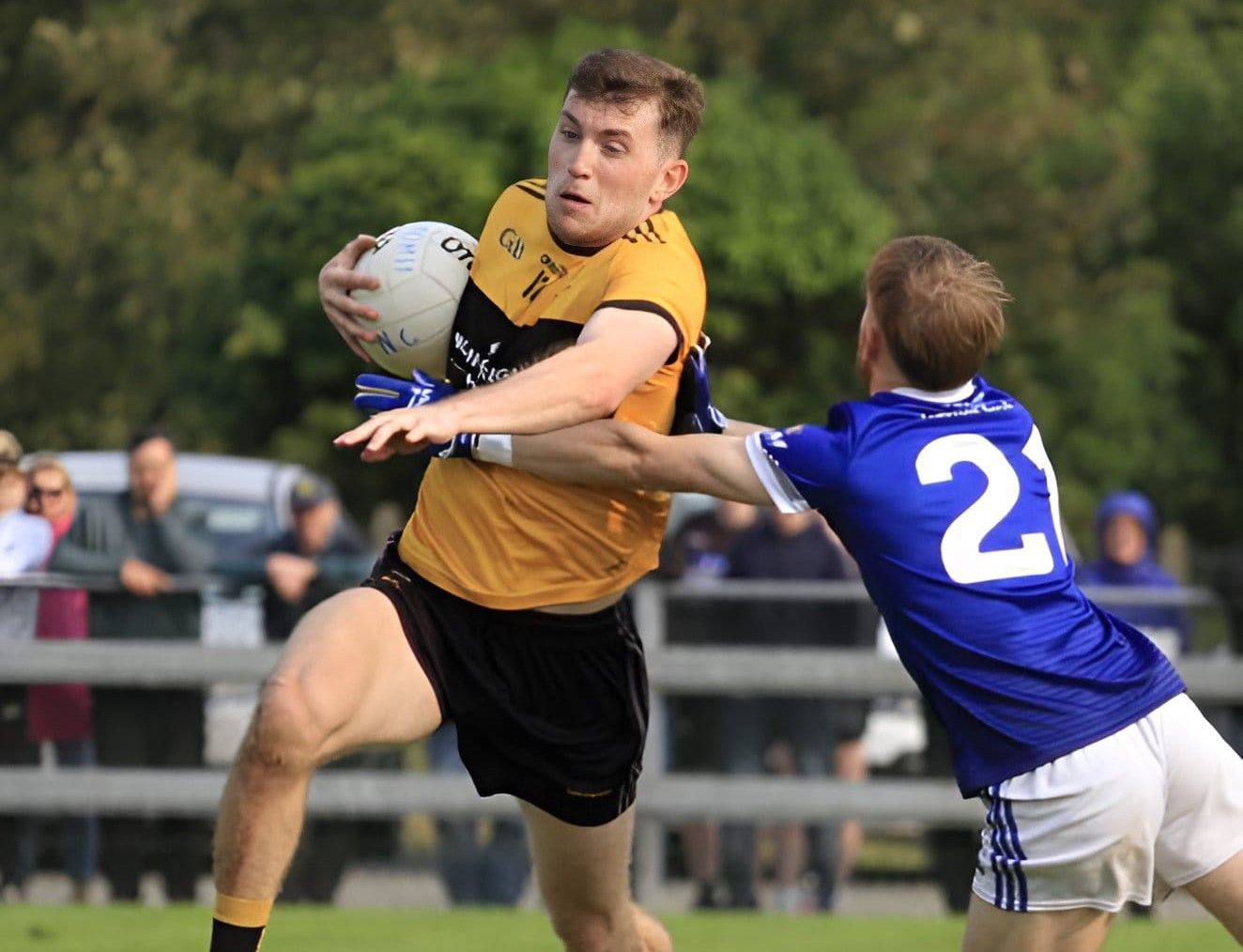
Joe Sheridan’s goal, July 11th, 2010, you may stand down. Your unflattering run as the most contentious and – whisper it – wrongly awarded score in the history of the game is over. That dubious mantle now belongs to the left boot of Scotstown and former Monaghan star Kieran Hughes after Tyrone referee Ciaran Eanetta overruled his own umpires and declared the free kicked by the aforementioned in the last play of extra time to be a score even though neither man at the goalposts seemed remotely convinced of the fact.
In fairness to them, of course, they didn’t have the benefit of numerous replays and slowed down camera angles which have been reprised ad nauseum on television and across social media since Saturday night last.
At this point, I should make clear that I have no skin in the matter either way but would be fairly certain St Eunan’s would have a fairly cut and dry case if they were to lodge an objection to the result. Not that there is any indication the Donegal club will do so, just an observation on my behalf.
As well as seeing the vastly viewed footage, a broad canvass of club and county players and a couple of managers imparted the view that once a ball goes over the post it is deemed to be wide.
However, where, in typical GAA fashion, the waters get muddy is this – once a score has been awarded, by rule it cannot be undone. Yes, exactly the scenario with Joe’s goal. BUT where I – and maybe more – are flummoxed by that reality is memory of an incident all of 31 years ago.
When Carlow were awarded a replay after a ‘point’ credited to Mick Turley of Laois was clearly and correctly identified as being wide. However, the only reason I can discern for the latter being amended is that the referee in question must have owned up to his error. No danger of Martin Sludden or the lad in Enniskillen the other night doing that. Pure coincidence that they’re from the same county I’m sure!
https://twitter.com/TsuDhoNim/status/2124791554954887279/photo/1
If, however, as appears to be the case on the basis of the above, questioning the awarding of a score is deemed out of order as things currently sit, does it not underline the necessity for every inter county ground – at the very least – to have HawkEye facilities available. Indeed, with the technology available now, it shouldn’t be beyond possibility for club grounds to have a drone or some similar type camera system feeding footage back to a PC, laptop or similar type device within a matter of seconds.

Nobody disputes the fact that human error can occur – the clue is in the name, human. Even the Pope eventually has to meet his maker. And, as has often been said in this space, the last man who never made a mistake was crucified on the curiously titled Good Friday – it hardly was for him!
Surely though, where there is a clear and obvious error – the Sheridan goal or the Turley point – for the sake of the minute or two it would take to run to the sideline and view on a screen. Thereby avoiding the situation where St Eunan’s, Carlow and, yes, Louth were done by a blatantly wrong decision.
When Mayo were the beneficiaries of a similarly wrong call against Monaghan earlier this year, the point was made – pun entirely intended – that, if the GAA are to really embrace the use and benefit of HawkEye technology, it has to be at all (inter county) grounds or none. Personally, I feel that if the technology is available, it should be used for any points of contention it can be, but, for it to be used to a minimum point of viability, dubious scores at all grounds should be a given in terms of what it’s used for.

Those are the problems the GAA should be looking at eradicating, not whether a player’s boot crosses a white line whilst taking a line ball. If you haven’t heard, as well as throwing out the idea of a four point goal, a meeting of some of the Association’s, eh, enlightened souls, decided to bring in sanction for when a player crosses the literal sideline when executing a kick from said location.
True, we have been here before. It would also be true to assert that when that was the case, the dictum in question was enforced for about a month and, like many a GAA rule before it, sent to a shelf somewhere to gather dust.
The other newbies in terms of forthcoming stipulations include an increase in the number of subs permitted from five to six, – if I am reading the following correctly – uniformity across all frees for decent and/or kickout infractions and defensive breaches to them all being 13m in distance. Also included is a more proper definition of the denial of what’s considered to be a genuine goal scoring opportunity – a hot topic in another code presently.
In our case, the dictum decrees that a player doesn’t need to have possession/control of the ball to be deemed to have been denied a clear goal scoring opportunity. You suspect this particular development is a hark back to and upgrading of what essentially became the Black Card rule after Sean Cavanagh took Conor McManus clean out of it when he was about to pull the trigger on goal.
Of course, as is always the case during the silly season when experimenting with the playing rules is the top item on the GAA’s agenda, for all that is brought in, there will also be those ideas that do get shelved. Either until the will of the people bends that of the power brokers or shelved until somebody shows enough interest in it to dust it off again.
Presently, into the latter category go the four-point goal and the hand passed point and the limit on the handpass and the introduction of a back court foul. Which, for those not au fait with the concept, is a piece of parlance from basketball, which, simply, precludes a team from passing the ball backwards from the half way line towards their own goal area. If it had received the green light, the penalty would have been the equivalent of the two free throws in the faced paced, five-a-side fare, a 13m free.
Other than that, since it was brought in and then wrongly done away with nearly 33 years ago, this corner has longed and campaigned for the rule limiting the number of consecutive handpasses to two before the ball must be kicked to be reinstated. Time and tide have proven that if enough pressure is sustained on the decision makers, desired changes can eventually be brought into effect.
See things like red, yellow and black cards, the Mark, electronic substitution boards and the (under) use of HawkEye is reference points for the fact that desired alterations can be got over the line. Similarly, now, we can but hope that pressure will be maintained, causing an eventual revisiting of:
- The current ludicrous situation with the Hooter – it needs to go back to its original iteration – that the match is not over until the ball goes dead.
- The limiting of the handpass – personally I’d ban it altogether but sure the poor conservatives would combust at the mere thought.
- A back court rule – specifically, precluding a team from passing the ball back inside their own 45.
- Return to sideline balls being taken off the ground.
- Two points for a sideline cut scored directly in hurling.
- A Mark to be awarded for any overhead catch in hurling from a pass/shot if the sliotar travels direct between the two 65m lines
- A proper definition of the handpass in hurling – maybe something along the lines of the handball motion in which the ball is basically tossed up and then struck with the open hand. Rather than what currently passes as a handpass which is basically like a cross between a delivery in baseball and cricket.
- Puc outs to be taken from the 21m line off the ground.
Any or all of the above would surely generate a bit of curiosity and interest, whereas the five new bullet points sanctioned last Saturday will, I fear, risk making Gaelic football boring again.
But I hope they prove me wrong!
Leave a Reply